
Blog
Looking for a premium replacement? Buy American diploma replicas crafted with precision. We use high-quality paper, authentic raised seals, and accurate typography to match real US universities. Fast shipping and 100% satisfaction guaranteed.
How to Get a Fake Diploma? Risks, Scams, Legal Consequences, and Legitimate Alternatives
People searching for “how to get a fake diploma” may have very different intentions. Some are curious about novelty certificates for entertainment, while others may have lost an original diploma and need a replacement. Some people are under pressure to meet employment requirements, qualify for a promotion, satisfy family expectations, or present educational documents for an application.
However, purchasing or using a fake academic credential can create serious personal, professional, financial, and legal problems. A document that looks convincing does not become a genuine qualification simply because it contains a university name, embossed seal, signature, transcript, or verification number.
Employers, universities, licensing organizations, immigration authorities, and professional background-screening companies increasingly verify educational credentials directly with issuing institutions. As a result, using a false diploma is usually much riskier than people initially assume.
This article explains why people look for fake diplomas, how diploma scams typically operate, how credentials may be verified, what consequences can follow, and which legitimate alternatives are available.
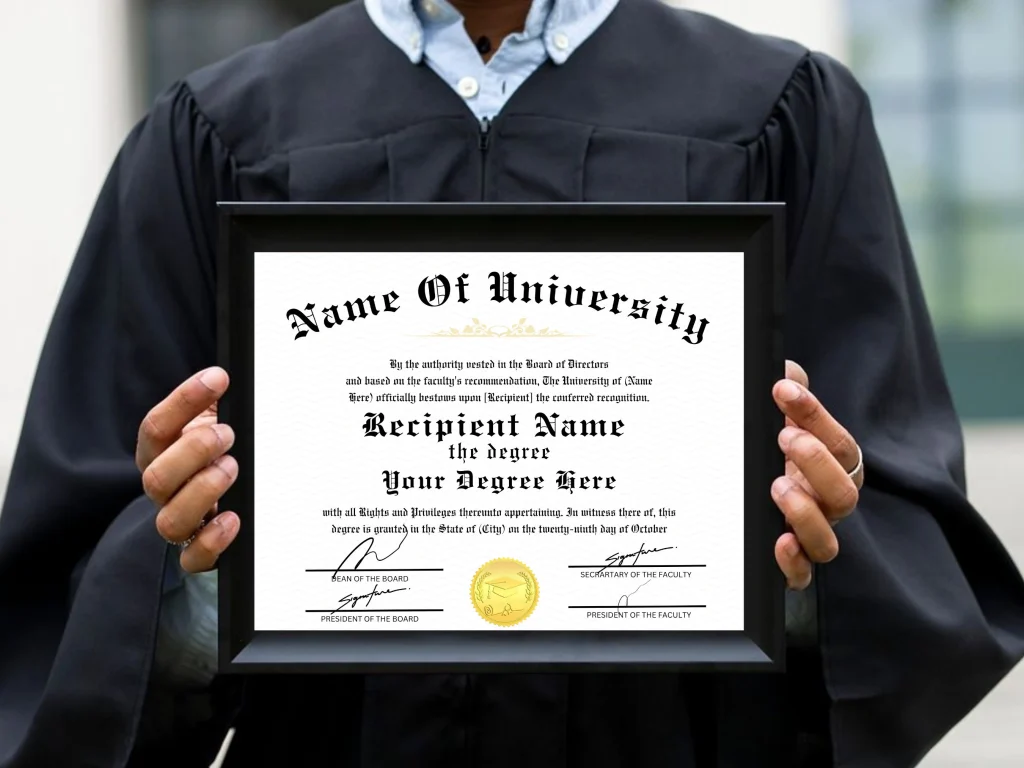
What Is Considered a Fake Diploma?
A fake diploma is generally a document that falsely represents a person as having completed an academic program, received a degree, or graduated from an educational institution.
Fake academic documents may include:
- Counterfeit university diplomas
- Altered graduation certificates
- Fabricated academic transcripts
- False professional certificates
- Documents using a real university’s name without authorization
- Degrees issued by organizations pretending to be accredited institutions
- Diplomas containing fake signatures, seals, student numbers, or verification codes
There is an important difference between an unauthorized academic credential and a novelty document.
A novelty certificate may be created for a film production, theatre performance, classroom demonstration, personal joke, or decorative purpose. It should be clearly marked as fictional, unofficial, a replica, or not valid for educational or professional use.
A document becomes especially problematic when it is designed or used to convince another person or organization that the holder earned a real qualification.
Why Do People Search for “How to Get a Fake Diploma”?
The keyword often reflects a problem rather than a genuine desire to commit fraud. Understanding the motivation can help identify a safer solution.
Employment Pressure
Some job listings require a bachelor’s or master’s degree even when the daily work is primarily based on practical experience. A qualified applicant may feel blocked by a formal educational requirement and consider presenting a false credential.
However, lying about a degree can turn a manageable qualification gap into a much more serious integrity issue.
Promotion Requirements
An employee may discover that advancement within a company requires a specific degree. Instead of discussing equivalent experience, internal training, or professional certification with the employer, the employee may consider using a fake diploma.
This is risky because internal promotions may involve more detailed background checks than the original hiring process.
Lost or Damaged Diplomas
Some searches come from graduates who earned a legitimate degree but no longer have the original document. A diploma may have been lost during relocation, damaged by water or fire, or stored by a family member.
In this situation, the correct solution is usually to request an official replacement diploma or certified academic record from the original institution.
Immigration or Visa Applications
Educational documents may be required for immigration, work authorization, professional registration, or international study.
Using false documentation in an official application can have consequences beyond ordinary employment screening. Applicants should obtain official records, certified translations, credential evaluations, or replacement documents instead.
Family or Social Expectations
Some people experience intense pressure to demonstrate academic success. They may want a diploma to show family members or display at home.
Although the document may not initially be intended for employment, the deception can still damage relationships and may eventually be used in other contexts.
Curiosity About Diploma Websites
Some users simply want to know whether websites advertising replacement degrees or realistic university diplomas are genuine. Many such websites use confusing language, combining terms such as “novelty,” “replacement,” “replica,” and “official-looking.”
Before ordering anything, consumers should understand what the seller is actually offering and whether the document could infringe institutional rights or be used deceptively.
How Fake Diploma Scams Commonly Work
Websites selling fake academic documents often attempt to appear professional. They may display university logos, printing equipment, customer testimonials, sample certificates, security features, and claims of confidentiality.
However, several common patterns should raise concern.
Claims of Undetectable Documents
A seller may claim that its documents are impossible to detect or guaranteed to pass verification.
No document provider can honestly guarantee that a false credential will survive direct verification with a university. An employer can contact the institution, use an authorized verification service, request sealed transcripts, or ask the applicant to provide additional academic records.
Fake Accreditation Claims
Some diploma businesses operate so-called diploma mills. These organizations may describe themselves as universities and issue degrees based on life experience, minimal coursework, or a one-time payment.
They may also claim accreditation from organizations that sound official but are not recognized by relevant educational authorities.
A professional-looking accreditation logo does not automatically mean that a school is legitimately accredited.
Misleading Replacement Diploma Services
A replacement diploma is normally issued to a person who genuinely graduated from the named institution. A legitimate replacement should be requested through the university, college, registrar’s office, alumni office, records department, or an officially authorized partner.
A third-party seller that creates a diploma from any university without verifying graduation is not providing an official replacement.
Fabricated Verification Services
Some sellers offer telephone answering services, websites, email addresses, or databases intended to confirm false credentials.
These systems may appear convincing during a superficial check, but they are not equivalent to confirmation from the real educational institution. A detailed background investigation can reveal that the domain, contact information, institution, accreditation body, or student record is not authentic.
Payment and Identity Risks
A buyer may be required to submit a full name, date of birth, photograph, signature, home address, employment information, passport details, or educational history.
Sharing this information with an anonymous diploma seller creates privacy and identity-theft risks. The customer may also have little protection if the seller disappears, misuses the data, demands additional payments, or threatens to expose the purchase.
Can Employers Detect a Fake Diploma?
Many employers can verify education more easily than applicants expect.
The exact process depends on the country, institution, company, position, and type of background check. Verification methods may include:
- Contacting the university registrar
- Using a recognized degree-verification provider
- Requesting an official transcript
- Asking for sealed or digitally certified records
- Confirming enrollment and graduation dates
- Checking the degree title and field of study
- Reviewing the institution’s accreditation status
- Comparing information across the résumé, application, and interview
- Contacting professional licensing authorities
- Requiring credential evaluation for international degrees
Visual quality alone does not establish authenticity. High-quality paper, holograms, embossed seals, foil stamping, signatures, and realistic layouts may make a diploma look genuine, but verification normally focuses on whether the academic record exists.
An employer may also discover a false qualification months or years after hiring. Verification can occur during a promotion, compliance audit, acquisition, security review, professional licensing application, government contract, or investigation into unrelated misconduct.
What Are the Risks of Using a Fake Diploma?
The consequences depend on how and where the document is used. They may range from reputational damage to termination, civil disputes, loss of professional licensing, or potential legal action.
Job Offer Withdrawal
A company may withdraw an offer when a background check reveals false educational information. Even when the degree was not essential to the role, dishonesty on the application may be treated as a separate issue.
Employment Termination
An employee who has already started work may be dismissed if the employer later discovers a false credential.
Long service, good performance, or relevant experience may not prevent termination because the employer may view the original application as dishonest.
Loss of Professional Reputation
Trust is especially important in management, finance, healthcare, engineering, education, law, compliance, and public-sector work.
Once false credentials become known, the individual may find it difficult to obtain references or rebuild professional credibility.
Professional Licensing Problems
Certain careers require approved education before a person can obtain a license or certification. False academic records submitted to a licensing organization may lead to application denial, suspension, revocation, or investigation.
A fake diploma should never be used to claim competence in a regulated field.
Financial Loss
Fake diploma websites may charge significant fees for diplomas, transcripts, verification packages, apostilles, seals, delivery, and so-called premium services.
The buyer may receive a poor-quality product, no document at all, or repeated requests for additional payment. Recovering money from an anonymous or overseas seller can be difficult.
Blackmail and Privacy Concerns
A dishonest provider may retain customer information and evidence of the transaction. The buyer may later face threats, unwanted contact, data exposure, or demands for more money.
Application and Immigration Consequences
False documents submitted to government agencies, immigration authorities, universities, or official credential evaluators can create severe consequences.
Anyone dealing with an official application should use genuine records and seek qualified professional advice when documents are unavailable.
Are Fake Diplomas Illegal?
The legal answer depends on the jurisdiction, the type of document, the way it was produced, and how it was used.
A decorative or fictional certificate that is clearly labeled as unofficial may be treated differently from a counterfeit diploma presented to obtain employment, admission, licensing, money, immigration benefits, or another advantage.
Potential legal concerns may include:
- Fraud or attempted fraud
- False statements
- Forgery
- Misrepresentation
- Identity-related offenses
- Trademark infringement
- Copyright infringement
- Unauthorized use of institutional seals
- Violations involving professional licensing
- Submission of false documents to public authorities
Because laws vary, anyone facing a real dispute or investigation should consult a qualified lawyer in the relevant jurisdiction. A seller’s claim that a product is “for novelty use only” does not protect a buyer who later uses it deceptively.
Fake Diploma vs. Replacement Diploma
People often confuse these two terms.
A fake diploma falsely claims that a person earned a qualification. An official replacement diploma is a reissued copy of a credential that the person genuinely earned.
A replacement diploma can usually be requested by contacting:
- The university registrar
- The academic records office
- The graduation office
- The alumni department
- The institution’s official document provider
- The institution that absorbed or replaced a closed school
- The relevant education authority, if records were transferred
The institution may request identification, graduation details, a signed application, and a processing fee. Delivery may take time, especially for older records or international shipping.
When an original diploma is unavailable, an official transcript, graduation letter, degree verification statement, or digitally authenticated academic record may also satisfy an employer.
What Should You Do If Your School Closed?
A closed school does not necessarily mean that academic records have disappeared.
Records may have been transferred to:
- Another university
- A state or regional education department
- A national education authority
- A records custodian
- An accreditation organization
- A court-appointed administrator
- A government archive
Search for official announcements about the institution’s closure and records management. Avoid websites claiming they can recreate an official degree without access to verified academic records.
For international applications, it may also be necessary to obtain a credential evaluation or certified translation.
Legitimate Alternatives to a Fake Diploma
People searching for how to get a fake diploma often have legitimate goals. The better approach is to address the actual requirement.
Request an Official Replacement
A genuine graduate who lost a diploma should contact the issuing institution. This is the safest and most direct solution.
Ask whether the school can provide:
- A replacement diploma
- A certified diploma copy
- An official transcript
- A graduation confirmation letter
- A secure digital credential
- A notarized or authenticated record
Complete an Accredited Online Degree
Many recognized institutions now offer flexible online, part-time, evening, and hybrid programs. These options may allow students to continue working while completing a legitimate qualification.
Before enrolling, verify the institution’s accreditation or recognition through the appropriate official education authority.
Use Professional Certifications
In some industries, a respected professional certification may be more valuable than an unrelated university degree.
Examples can include certifications in project management, information technology, digital marketing, accounting, data analytics, cybersecurity, design, logistics, and skilled trades.
The appropriate certification depends on the career and employer.
Build a Portfolio
For design, marketing, writing, programming, photography, video production, web development, and other portfolio-based careers, strong work samples can demonstrate ability more effectively than a false degree.
A portfolio may include:
- Completed projects
- Case studies
- Performance data
- Client testimonials
- Before-and-after examples
- Technical documentation
- Published work
- Open-source contributions
Present Experience Honestly
Applicants without a degree can emphasize relevant experience, measurable results, technical skills, leadership, and industry knowledge.
Instead of listing a degree that was never earned, a résumé can state:
- Coursework completed
- Credits earned
- Expected graduation date
- Professional training
- Industry certifications
- Relevant workshops
- Apprenticeships
- Military training
- Independent projects
The wording must remain accurate. Attending a university is not the same as graduating from it.
Ask About Equivalent Experience
Some job descriptions treat a degree as preferred rather than mandatory. Others accept equivalent professional experience.
A candidate can contact the recruiter and ask whether substantial work experience, certifications, or a portfolio may satisfy the requirement.
Consider Prior Learning Assessment
Some recognized institutions award academic credit for previous learning, military training, professional qualifications, examinations, or documented workplace experience.
Prior learning assessment does not mean purchasing a degree. Students must still meet institutional requirements, and the process should occur through a legitimate school.
Apply for Entry-Level or Skills-Based Roles
A position requiring a degree may not be the only path into an industry. Entry-level employment, apprenticeships, contract projects, internships, and freelance work can help a person build verified experience.
Over time, this experience can open opportunities that do not depend on a specific academic qualification.
How to Identify a Legitimate Educational Institution
Before paying for any degree program, confirm that the institution is genuine.
Look for:
- Recognition by an official education authority
- Accreditation from a recognized accrediting organization
- Transparent admission requirements
- Real coursework and academic assessment
- Qualified faculty members
- Clear tuition and refund policies
- A verifiable physical or institutional presence
- Official student support services
- Published graduation requirements
- Secure methods for verifying credentials
Be cautious when a provider:
- Guarantees a degree within days
- Awards a degree only for payment
- Requires little or no coursework
- Promises backdated graduation
- Offers any university name requested
- Sells transcripts separately
- Claims its documents are undetectable
- Uses vague accreditation language
- Pressures customers to pay immediately
- Accepts no responsibility for verification
What If You Already Used a Fake Diploma?
Ignoring the issue may make the situation worse, especially if the credential is being used for employment, licensing, education, immigration, or a government application.
The appropriate response depends on the circumstances. Consider stopping further use of the document and obtaining advice from a qualified lawyer or relevant professional before making statements that could create additional consequences.
A person may also need to:
- Correct inaccurate résumé information
- Update an employment application
- Withdraw an unsupported credential
- Obtain genuine academic records
- Complete the required qualification
- Speak with an employer’s human resources department
- Contact the relevant licensing or admissions body
- Preserve records relating to the diploma seller
- Report identity theft or financial fraud when applicable
Do not attempt to solve the problem by purchasing additional fake transcripts, verification services, reference letters, or supporting documents. Adding more false information usually increases the risk.
Frequently Asked Questions
Can I Buy a Diploma as a Novelty Item?
Novelty certificates may be used for entertainment, decoration, theatre, film, or private jokes when they are clearly identified as unofficial and are not designed to deceive.
Avoid documents that copy a real institution’s protected branding, seals, signatures, or security features without authorization.
Can a Fake Diploma Pass a Background Check?
A fake diploma may escape a very limited check, but it can fail whenever the employer directly verifies the academic record.
There is no reliable way to guarantee that a false qualification will remain undiscovered.
Can I Replace a Diploma Without Contacting My University?
An official replacement normally comes from the institution or its authorized records provider. A third-party printing company cannot independently create a genuine academic record.
Is a Life-Experience Degree Legitimate?
Some accredited institutions may award limited credit for documented prior learning. However, organizations that sell complete degrees primarily based on a résumé or payment should be treated with caution.
Verify recognition through an official education authority before enrolling.
Can I List an Unfinished Degree on My Résumé?
Yes, provided the information is accurate. You may list the institution, field of study, dates attended, credits completed, or expected graduation date.
Do not state that a degree was awarded when it was not.
What Can I Use Instead of a Diploma?
Depending on the requirement, alternatives may include an official transcript, graduation confirmation letter, digital credential, professional certification, portfolio, apprenticeship record, credential evaluation, or documented work experience.
Final Thoughts
Searching for “how to get a fake diploma” may appear to offer a quick solution to an educational or career obstacle. In reality, a false academic credential can create long-term risks involving employment, reputation, finances, privacy, licensing, and legal liability.
The appearance of a document is not the same as the existence of a real academic record. Employers and institutions can verify graduation directly, and a false qualification may be discovered long after it was first submitted.
A better solution is to identify the actual problem. Someone who lost a genuine diploma can request a replacement. Someone who lacks a degree can pursue accredited online study, professional certification, prior learning assessment, portfolio development, or experience-based employment.
A legitimate qualification may require more time and effort, but it creates real value. A fake diploma creates only the appearance of progress—and the risk of losing opportunities that could have been earned honestly.