
American Diplomas
Looking for a high-quality alternative? Buy our meticulously crafted replicas of university diplomas from around the world. We use premium paper, authentic embossing, and precise fonts to ensure perfect imitation of genuine diplomas from various universities worldwide. Fast shipping and a 100% satisfaction guarantee. Contact us if you don’t find what you need.
Florida Gulf Coast University diploma care made simple
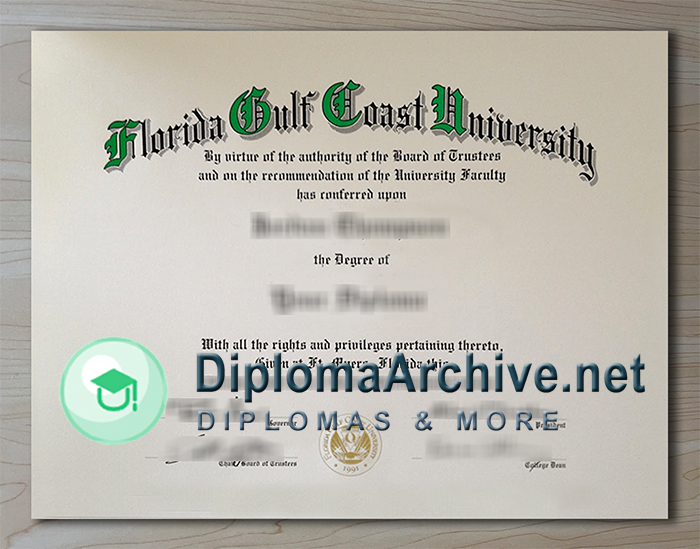
Introduction to Florida Gulf Coast University
Florida Gulf Coast University (FGCU) is a public university in Southwest Florida. The university was established in 1991 as Florida’s 10th state university, and it welcomed its first students in August 1997. From a new regional institution, FGCU has developed into a university with a broad selection of undergraduate, graduate, and doctoral programs.
Today, Florida Gulf Coast University focuses on practical learning, research, community engagement, and career preparation. Its academic offerings include undergraduate programs, master’s degrees, doctoral programs, and certificate options. In addition, students can choose from classroom, online, evening, and weekend learning formats.Fresno Pacific University Diploma Secure Storage Tips.
A Short History of Florida Gulf Coast University
The story of FGCU began with a strong regional demand for a public university in Southwest Florida. In 1991, legislation authorized the creation of the state’s tenth university. Soon afterward, a 760-acre site between Fort Myers and Naples was selected for the future campus.
Construction followed, and the university officially opened its doors on August 25, 1997. At that time, 2,584 students enrolled. The first official commencement followed in May 1998, when 81 students graduated.
Since then, the institution has expanded considerably. FGCU now reports around 16,000 students, 66 undergraduate programs, 28 master’s programs, and seven doctoral programs. Therefore, its academic profile is much broader than the university’s early years.
Featured Programs and Academic Opportunities
Florida Gulf Coast University offers programs across several academic areas. Students can explore fields such as business, health professions, engineering, education, science, communication, criminal justice, psychology, history, political science, and the arts.
For example, the College of Arts and Sciences offers programs in biology, biotechnology, chemistry, communication, criminal justice, forensic science, mathematics, psychology, sociology, and other disciplines. The university also provides graduate options in areas such as biology, criminal justice, forensic studies, history, mathematics, and public administration.
The History program provides another good example of FGCU’s practical academic approach. Students develop research, communication, critical-thinking, and analytical skills through coursework and internships. These abilities can support careers in education, law, public policy, journalism, museums, government, and other professional fields.
Furthermore, FGCU emphasizes learning beyond traditional classrooms. Research opportunities, internships, service learning, and community projects can help students connect academic knowledge with real-world situations.
Campus Culture and Student Experience
Campus culture is another important part of the Florida Gulf Coast University experience. FGCU describes its community as active, welcoming, and student-focused. Students can participate in hundreds of student organizations, along with athletics, campus events, research activities, and community programs.
The university also places strong emphasis on personal interaction. FGCU reports a 22:1 student-to-faculty ratio, while many undergraduate students have opportunities to work with faculty on research.
As a result, the diploma represents more than the completion of a set of courses. It is connected to a broader academic experience that includes study, projects, practical activities, and participation in the university community.
Why Proper Diploma Preservation Matters
After graduation, a Florida Gulf Coast University diploma can become an important long-term academic record. Graduates may need credential information when applying for employment, professional opportunities, further education, or other situations that require proof of academic achievement.
However, paper documents can face everyday risks. Water, accidental spills, folding, sunlight, moving, storage pressure, and improper handling may gradually affect a diploma’s condition. Therefore, graduates should treat their original diploma as an important document rather than an ordinary piece of paper.
A simple preservation routine can make a difference. Keep the diploma in a dry, stable environment and avoid direct sunlight. A suitable archival folder or protective document sleeve can also reduce unnecessary handling. For particularly important documents, graduates may consider keeping a high-quality digital scan as a backup reference.
What to Do If a Florida Gulf Coast University Diploma Is Damaged
If a diploma becomes damaged or lost, the safest approach is to contact Florida Gulf Coast University and follow its official replacement procedure. FGCU’s Records and Registration office provides a specific Replacement Diploma Form, so graduates do not need to rely on unofficial sources.
FGCU’s current tuition and fees information also lists a $10 diploma replacement fee.
The exact processing requirements and delivery time can depend on the university’s current procedures. Therefore, graduates should confirm the latest requirements directly with the university before submitting a request.
For people facing an urgent employment or education deadline, early preparation can help. Keeping personal academic records organized, maintaining a secure digital reference copy, and contacting the university promptly can reduce unnecessary delays.
Who Can Benefit From Diploma Preservation Support?
Diploma preservation guidance can be useful for recent graduates, alumni preparing for career changes, professionals organizing academic records, and anyone who wants to protect important education documents for long-term use.
Most importantly, graduates should always use official university records when formal verification is required. Employers and educational institutions may use verification procedures to confirm academic credentials, so an unofficial reproduction should never replace an official diploma or university-issued record.
For this reason, a responsible document service should focus on safe storage, scanning, organization, protective presentation, and guidance on official replacement procedures rather than representing unofficial documents as university-issued credentials.
Final Thoughts
Florida Gulf Coast University has grown from a new Southwest Florida institution into a comprehensive public university with a wide range of academic programs and an active campus community. Its focus on practical learning, research, internships, and community engagement gives students opportunities to build skills that extend beyond the classroom.
A Florida Gulf Coast University diploma can remain valuable long after graduation. Therefore, proper preservation is worth taking seriously. If accidental damage or loss occurs, the best solution is to follow FGCU’s official replacement process and keep reliable academic records available for future needs.
By combining careful document preservation with official university procedures, graduates can protect their academic history while keeping future education and employment opportunities easier to manage.