
Blog
Looking for a premium replacement? Buy American diploma replicas crafted with precision. We use high-quality paper, authentic raised seals, and accurate typography to match real US universities. Fast shipping and 100% satisfaction guaranteed.
The 2026 US College Graduate Job Market: Your Diploma Won’t Guarantee a Job, But It’s Far From Useless
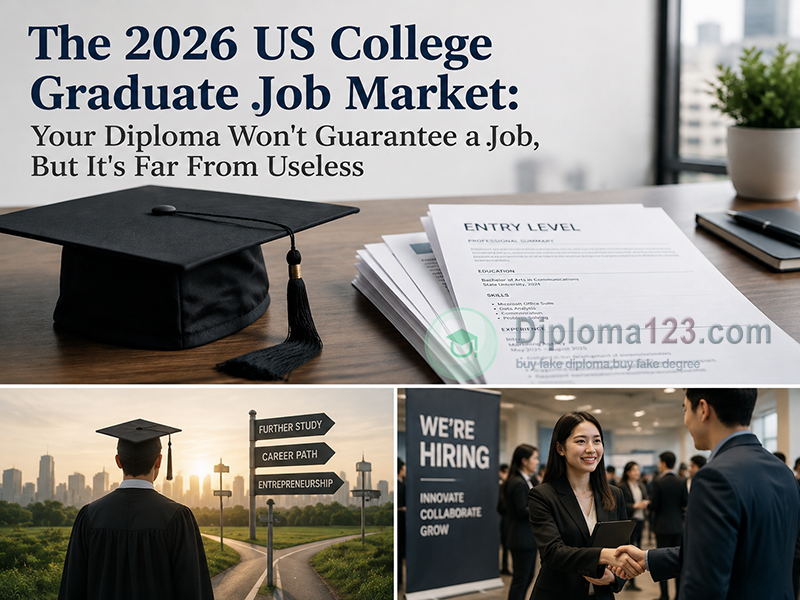
The 2026 US College Graduate Job Market: Your Diploma Won’t Guarantee a Job, But It’s Far From Useless
Subtitle: Starting with the 42% Underemployment Rate—How the Class of 2026 Should Rethink Their Degree, Plan a Career, and Store That Piece of Paper
Walk into any American college graduation ceremony in spring 2026, How to Quickly Obtain a U.S. Diploma.and the mood in the air is likely split: half relief at holding the diploma, half quiet anxiety about sending out resumes next week. That anxiety is not unfounded. By the second quarter of 2026, the underemployment rate for recent college graduates—those working jobs that typically don’t require a bachelor’s degree—had climbed to roughly 42%, while the unemployment rate for this group held at about 5.6%, according to the Federal Reserve Bank of New York . The National Association of Colleges and Employers (NACE) initially projected a flat market, but later revised its spring outlook upward to a 5.6% increase in hiring for the Class of 2026, concentrated in information, engineering services, construction, and wholesale trade .
The picture is complicated, and far more nuanced than the headline numbers suggest.
First, the Data: The Diploma Premium Is Shrinking, But Not Gone
The long-term trend is hard to ignore. The earnings gap between bachelor’s and high school graduates has narrowed over the past decade. But the degree still matters, especially when compared correctly. As of March 2026, 7.2% of 22-to-27-year-olds without a college degree were unemployed, compared with 5.6% of those with one . The gap has narrowed, but it persists.
Jaison Abel, head of microeconomics at the New York Fed, cautions against comparing recent graduates to the entire workforce. “Recent graduates are all very much on the margins of the labor market,” he told Inside Higher Ed. The apples-to-apples comparison is against young workers of the same age without a degree—and there, the degree still provides a measurable edge . What has changed is the speed of transition. The degree no longer accelerates the move from “unemployed” to “employed” the way it once did. It gets you into the race; it doesn’t guarantee you a head start.
The Real Problem: Entry-Level Roles Are Being Squeezed from Both Ends
The most uncomfortable feature of the 2026 market is the structural contraction of entry-level white-collar work. A Gartner survey of HR leaders found that 22% reported at least one business leader in their organization had stopped hiring for entry-level roles due to AI automation . The tasks that traditionally went to new hires—document drafting, basic coding, initial contract review, simple data analysis—are increasingly handled by software.
At the same time, employers are more cautious after waves of layoffs. Job openings at the end of 2025 fell to 6.5 million, the lowest since September 2020 . Major employers like Amazon and Citigroup have cut positions, and the federal government slashed hundreds of thousands of roles that once absorbed liberal arts and social science graduates.
But the doors are not all closed. The split is stark. Healthcare added jobs steadily, and nursing consistently posts the lowest underemployment rate of any major . Data science, information security, and civil engineering remain on every “best bets for new grads” list. Meanwhile, AI startups are paying top technical talent entry-level packages that can reach $200,000 or more in base salary. The fire and ice are simultaneous: generic degrees are depreciating while skill-specific degrees are appreciating.
Career Planning: Treat College as a Runway, Not a Waiting Room
The most dangerous strategy in this market is waiting until senior year to start thinking about employment. The students landing good offers often began treating internships, projects, and networking as required coursework from sophomore year—or earlier. NACE data shows employers planned to hire 3.9% more interns in the 2025-26 cycle, and a separate study found that internship experience can cut the probability of underemployment nearly in half .
Three practical moves deserve serious attention.
First, cultivate “AI-resistant” skills without romanticizing them. Nursing, engineering, construction management, and physical therapy require licenses, hands-on work, or face-to-face interaction—tasks with high automation thresholds . If you’re in the humanities or social sciences, the answer is not despair but layering: add data analysis, project management, or basic coding as a second competency. A resume that reads “knows content and knows tools” beats one that only complains about the major.
Second, widen your search beyond the marquee names. The 5.6% hiring increase is concentrated in information, engineering services, construction, and wholesale trade—not necessarily the tech giants . Mid-sized firms and non-profits may not offer glamorous salaries, but they often give new hires broader exposure. In three to five years, that breadth is worth more than a “big tech cog” line on a resume.
Third, accept that your first job is not your forever job. With underemployment at 42%, many graduates will take a role that doesn’t require their degree. That is neither shameful nor permanent. The key question is whether you are managing the transition—maintaining a portfolio, earning a certificate, doing a remote internship—while working the transitional job. The length of the detour often depends on whether you treat it as one.
The Diploma: What It’s Actually For, and How to Keep It Safe
Beyond the job hunt, there is a practical question many graduates overlook: what your diploma actually does, and how to store it.
In the U.S. job market, the diploma’s first function is passing employer background checks. Most legitimate employers use third-party verification. If your degree cannot be confirmed, an offer can be rescinded. Second, it is the gateway to professional licensure—nurses, accountants, engineers, teachers, and many others cannot sit for exams without it. For international students, the degree type directly affects OPT eligibility and H-1B sponsorship categories.
As for storage: do not keep the original in a rental drawer or carry it around. Scan a high-resolution PDF and store it in the cloud. Keep the original in a fireproof, waterproof envelope at a parent’s home or a bank safe deposit box. No legitimate employer will ask for the original during an interview. If you are an international student planning to return to your home country, check whether your school issues electronic diplomas or can mail replacements—Chinese credential verification processes often require a scanned original, and planning ahead is far easier than scrambling later.
The Bottom Line
The Class of 2026 is not entering the best of times, but it is far from the worst. The diploma’s “guarantee” function has faded. It no longer promises a white-collar entry-level job, and it certainly does not promise a four-year return on investment. But it remains a necessary filter: it qualifies you for certain tracks and signals to employers that you can complete a long-term commitment. What happens after you enter the track depends on internships, skills, adaptability, and a bit of luck.
Don’t enshrine the diploma. Don’t throw it away either. Store it properly, then go do the things that matter more.